eh?
# **!/bin/bash**
end=$((SECONDS+300))
mkdir -p samay
cd samay
while [ $SECONDS -lt $end ]; do
# Do what you want.
touch $(date "+%F-%T")_file.txt
sleep 60
aws s3 sync ../samay s3://gaddagi-testing-files/ --region ap-south-1
:
done
# **!/bin/bash**
end=$((SECONDS+300))
mkdir -p samay
cd samay
while [ $SECONDS -lt $end ]; do
# Do what you want.
touch $(date "+%F-%T")_file.txt
sleep 60
aws s3 sync ../samay s3://gaddagi-testing-files/ --region ap-south-1
:
done
Part of the Building the Log Package series How I thought through the log package design before writing any code When I was working through the store object, the whole idea was clear enough when bytes are given, append and when a position is given, read. Pretty simple interface. But
Part of the Building the Log Package series How I thought through the log package design before writing any code The five layers of the log package are easiest to understand by tracing one record through all of them. The scenario Building a chat app. Messages come in: "hello&
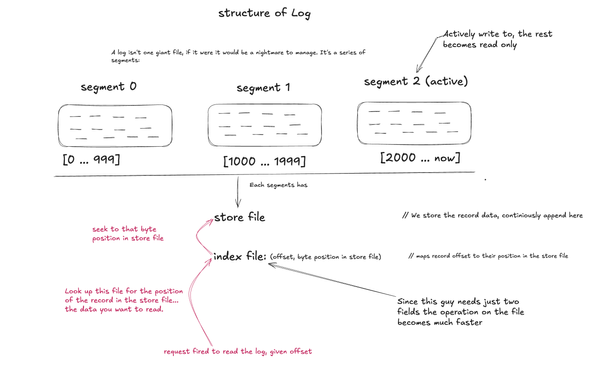
📖Distributed Services with Go by Travis Jeffery; Chapter 3. Here's what clicked. Understanding the structure of a log is one aspect of learning curve. And sitting down to build it in Go is a whole different trajectory! Here's how the progression looked. Step 0: Co-relations; Why
Part of the Building the Log Package series How I thought through the log package design before writing any code Syscalls are not free they involve a context switch from user space to kernel space. Your Go program runs in user space think of it as a regular employee working